What we study
In the Analytical Sciences Laboratory, three types of key activities are performed:
- Discovering new components e.g. in human milk
- Analysing samples from pre-clinical work (mainly coming from the Life Sciences Laboratory on the 4th floor) e.g. cell culture or samples from digestion experiments TIM, and also samples from our clinical trials
- Analysing the composition of our products during our product development process for example the scGOS/IcFOS content in our infant formulas
The analytical sciences laboratory is ISO NEN-EN ISO 9001:2015 certificated.
Key messages Human Milk Research
- Human milk and breastfeeding, the best nourishment for a baby
The benefits of human milk include optimal growth, maturation & development, less allergies & infections, brain & eye development and programming for later life. - Over 40 years of human milk research
- Human milk research supports
- Breastfeeding (mothers/ parents)
- Our innovation
- Inspired our innovations over years e.g. our patented scGOS/lcFOS 9:1 prebiotic mixture, LCPs, fat structure, bacteria (synbiotics/ postbiotics))
- Current research areas: variation of composition of breast milk, psychological factors impacting breastfeeding behaviour, External influences on breast milk composition (such as lifestyle, gender, health, diet, mixed feeding)
- We provide facilities for mothers to breastfeed (= express their milk during working hours)
- Internal survey on breastfeeding rates: At 4 months, 30% exclusive breastfeeding average in NL, and 60% in Danone women.
Interesting facts
- Human milk is variable:
DIET, LIFESTYLES, GENES and GENDER impact human milk composition
HEALTH STATUS of the mother (may) impact human milk composition- Energy content of breast milk for boys is higher
- HM for boys had 25% greater caloric content than HM for girls
- Boys grow faster than girls
- Thus, increased energy demand
- Breastfed boys consume more milk
- How the production of gender-specific milk is physiological regulated is not yet known.
- HM reflects the Health Status of the Infant
- During active infection in the nursing infant, the total number of white blood cells, specifically the number of macrophages, and TNFα levels in breast milk increase.
- Dynamic immunological connection between lactating mothers and their nursing infants
- Wallabies produce two different kinds of milk at the same time
- Milk for the developing joey inside the pouch
- Milk (e.g. higher fat) for the developed joey (outside the pouch)
- Each joey suckles on a different teat in order to get the right milk
- Energy content of breast milk for boys is higher
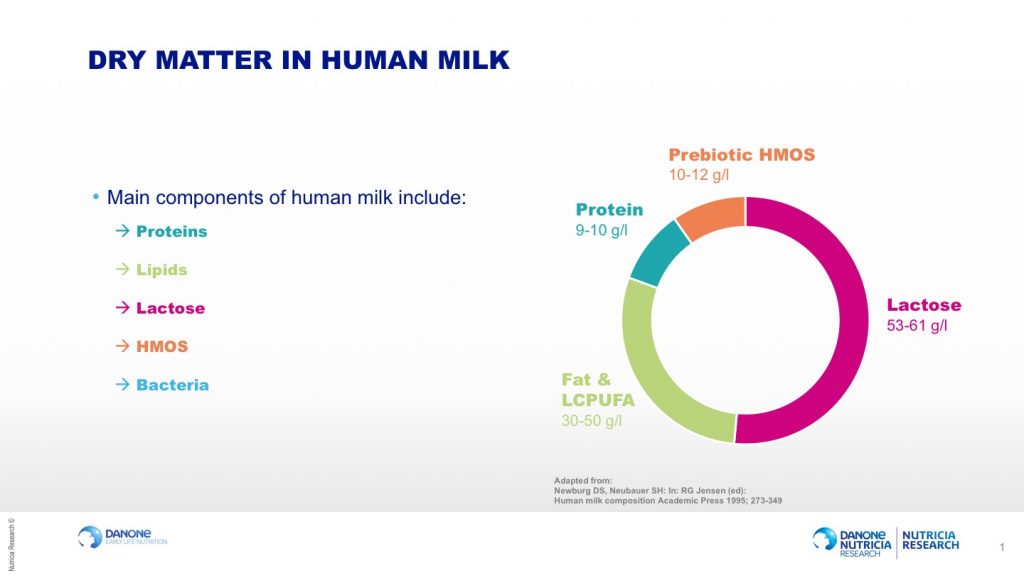
Composition HM:
88% Water
7% Carbohydrates
4.4% Fat
1.8% Minerals
1% Protein
What you can see
The mass spectrometry, the Malti-TOF-TOF, enables us to discover new compounds e.g. sugars and proteins– via detecting the mass of compounds. We can compare this mass to known compounds which allows us to approximate the molecular structure of unknown compounds. Actually the Maldi-TOF-TOF was used to discover prebiotics in human milk in the early 1990’s and we were able to find similar compounds in the nature, which we used to create our patented scGOS/lcFOS 9:1 mixture.